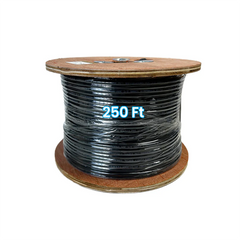
12/2 is the thicker wire. Use 14/2 for short, light runs (for example, up to about 90 ft with 100W of lights). Use 12/2 for longer or heavier runs (up to about 150 ft with 100W). Never load a 14/2 run past 144W or a 12/2 run past 192W, and buy 15% more cable than you measure.
What 12/2 and 14/2 mean
The first number is the wire gauge (AWG); the second is the number of conductors. Both are two-conductor cables made for low-voltage landscape lighting. The part that trips people up: the lower the gauge number, the thicker the wire. So 12/2 is thicker than 14/2, and 14/2 is thicker than 16/2.
Thicker copper has less resistance, so it carries power farther before the lights at the end start to dim. That is the whole decision: how many watts you put on a run, and how far that run goes.
Chapter 02Voltage drop, in plain words
Every foot of wire eats a little voltage. A 12V transformer tap feeds 12V at the start of the run; by the last fixture, a long or heavily loaded cable might deliver only 10V. LED lights look dimmer, flicker or change color when they get too little voltage.
Multi-tap transformers fix this by offering 13V, 14V and 15V outputs, so you can start higher and still land in the safe range. The target: at least 11V at the last light, and no more than about 15V at the first one.
Check your work with a cheap multimeter. Measure at the last fixture with the lights on. Under 11V? Move the run to a higher tap, split it into two runs, or switch to 12/2.
Wire gauge chart: watts vs distance
Find the total watts of the lights on one run, then read the maximum distance from the transformer to the last light. Figures assume a multi-tap transformer and lights grouped toward the end of the run, the worst case.
| Watts on the run | 14/2 max distance | 12/2 max distance |
|---|---|---|
| 20W (about 4 lights) | 470 ft | 749 ft |
| 50W (about 10 lights) | 188 ft | 299 ft |
| 100W (about 20 lights) | 94 ft | 149 ft |
| 150W (about 30 lights) | Over the 144W limit | 99 ft |
Light counts assume 5W LED fixtures. Above 192W on a single run, split the lights into two runs back to the transformer.
Chapter 04When to use 14/2, 12/2 or 16/2
How much wire to buy
- Measure each run from the transformer to the last light, following the real route around beds and under paths.
- Add the home runs together if you have several runs going in different directions.
- Add 15% for curves, loops at each fixture and connections. A 120 ft layout needs about 140 ft of cable.
- Round up to the next spool: 100, 250 or 500 ft. Leftover cable is handy when you add lights later.
Three ways to run the wire
| Method | How it works | Best for |
|---|---|---|
| Daisy chain | One cable goes from light to light. | Short runs with a few lights. Simplest, but the last lights get the least voltage. |
| T method | The home run connects to the middle of the light run. | Long paths and driveways. Brightness stays more even end to end. |
| Hub | Equal-length leads go to each light from one connection point. | Groups of lights in one area. The most even light, but uses more cable. |
Whatever the method, bury direct-burial cable a few inches deep (most installers go about 6 in; check your local code), keep it away from where you dig often, and seal every splice with waterproof connectors.
Chapter 07Match the transformer
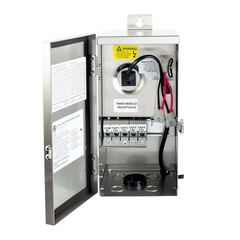
The wire carries the power; the transformer has to supply it. Add up the watts of every light on every run and multiply by 1.3. That 30% margin keeps the transformer cool and leaves room to grow. A yard with 150W of lights needs about 195W, so a 200W or 300W multi-tap transformer is the right size.
Want it done for you? Use the transformer calculator. It suggests the transformer, the gauge and how to split your runs.
Questions we hear most
Is 12 gauge or 14 gauge wire thicker?
12 gauge is thicker. With wire gauge, a lower number means a thicker wire, so 12/2 carries power farther with less voltage drop than 14/2.
How far can I run 14/2 landscape wire?
It depends on the load. With 50W of lights, about 188 ft; with 100W, about 94 ft. Never put more than 144W on a single 14/2 run.
How far can I run 12/2 landscape wire?
About 299 ft with 50W of lights and about 149 ft with 100W. Keep a single 12/2 run under 192W.
Can I use 16/2 wire for landscape lighting?
Only for short branches off a thicker main run. Do not connect 16/2 directly to the transformer.
How much landscape wire do I need?
Measure each run from the transformer to the last light, add them up, add 15% for curves and connections, then round up to the next spool size.
Why are my last landscape lights dim?
Usually voltage drop: the run is too long or too heavily loaded for the wire. Move it to a higher transformer tap, split it into two runs, switch to 12/2, or feed the run from the middle.